For years, European institutions and businesses have built their digital infrastructure on the foundations of American cloud providers — Amazon Web Services, Microsoft Azure, and Google Cloud. While these hyperscalers offer scalability and speed, they also bring growing concerns about compliance, autonomy, and long-term strategic risk.
As the geopolitical and regulatory landscape shifts, digital sovereignty is emerging not just as a political concept, but as a critical business priority. Companies that fail to address where and how their data is stored may soon find themselves exposed — legally, economically, and reputationally.
Cloud Dependency Comes at a Cost
Despite the EU’s strong regulatory frameworks and investments in innovation, around 92% of Western data is still hosted on U.S.-based infrastructure. Five non-European firms control over 80% of the global cloud market, with Amazon and Microsoft alone owning 38% of the EU’s cloud services.
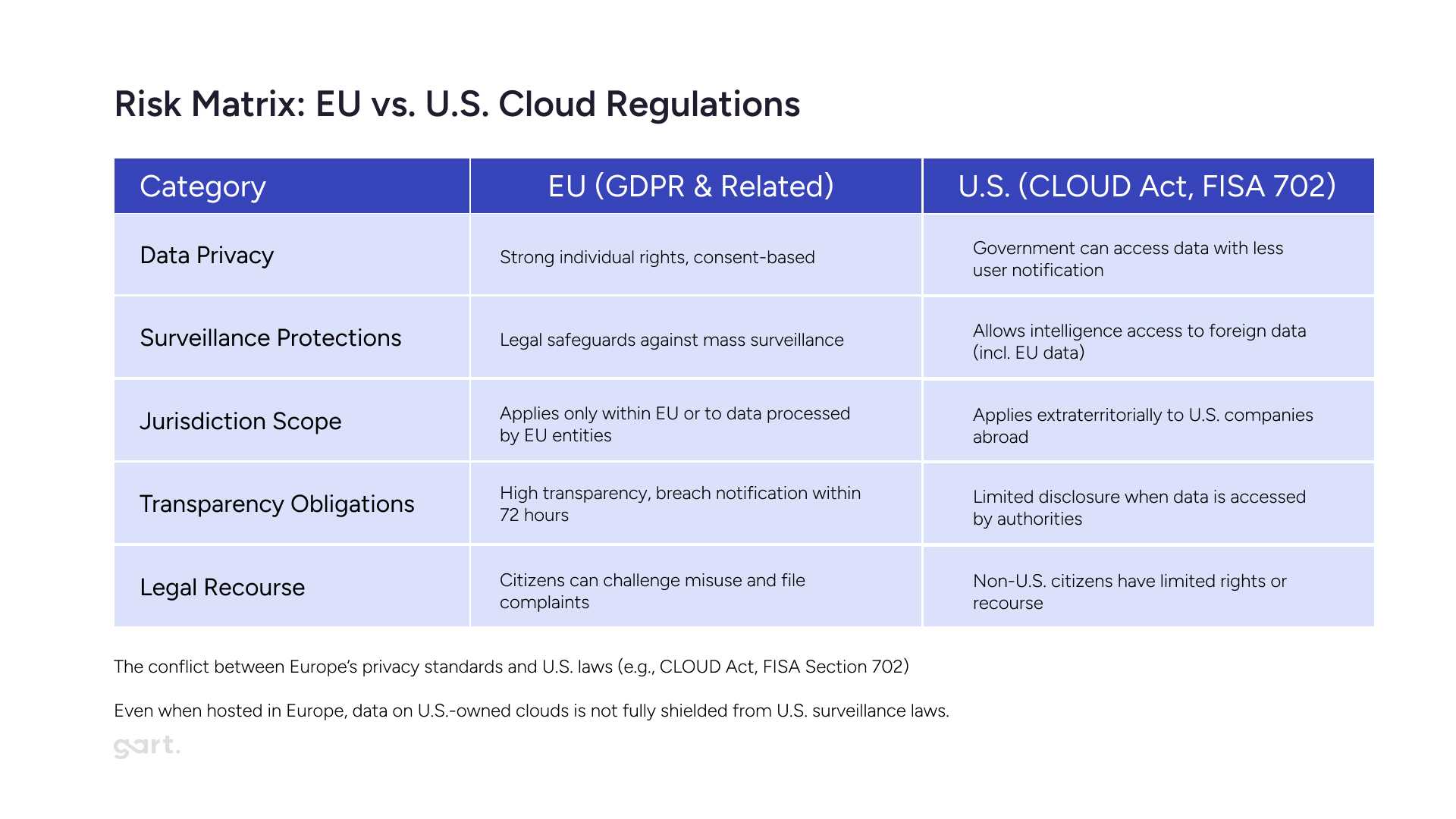
This dominance creates a legal gray zone for European companies. Even if data physically resides in Frankfurt or Paris, it can still fall under U.S. surveillance laws such as the CLOUD Act or FISA 702. In practice, this means foreign governments may legally request — and obtain — access to sensitive European business information without the data ever crossing a border.
The implications for business are substantial: legal uncertainty, regulatory conflicts with GDPR, and the looming threat of service disruption due to international sanctions or political disputes. For companies working with public institutions or processing personal data at scale, this level of exposure is unacceptable.
Digital sovereignty doesn’t mean building a digital wall around Europe or cutting ties with global technologies. It means having the right to choose, the power to control, and the tools to protect your digital assets — from infrastructure to identity.
For companies, this translates into four strategic imperatives:
This is no longer a “public sector” issue. In sectors like healthcare, finance, logistics, AI, and e-commerce, sovereignty is now a competitive advantage — and in some cases, a precondition for market access.
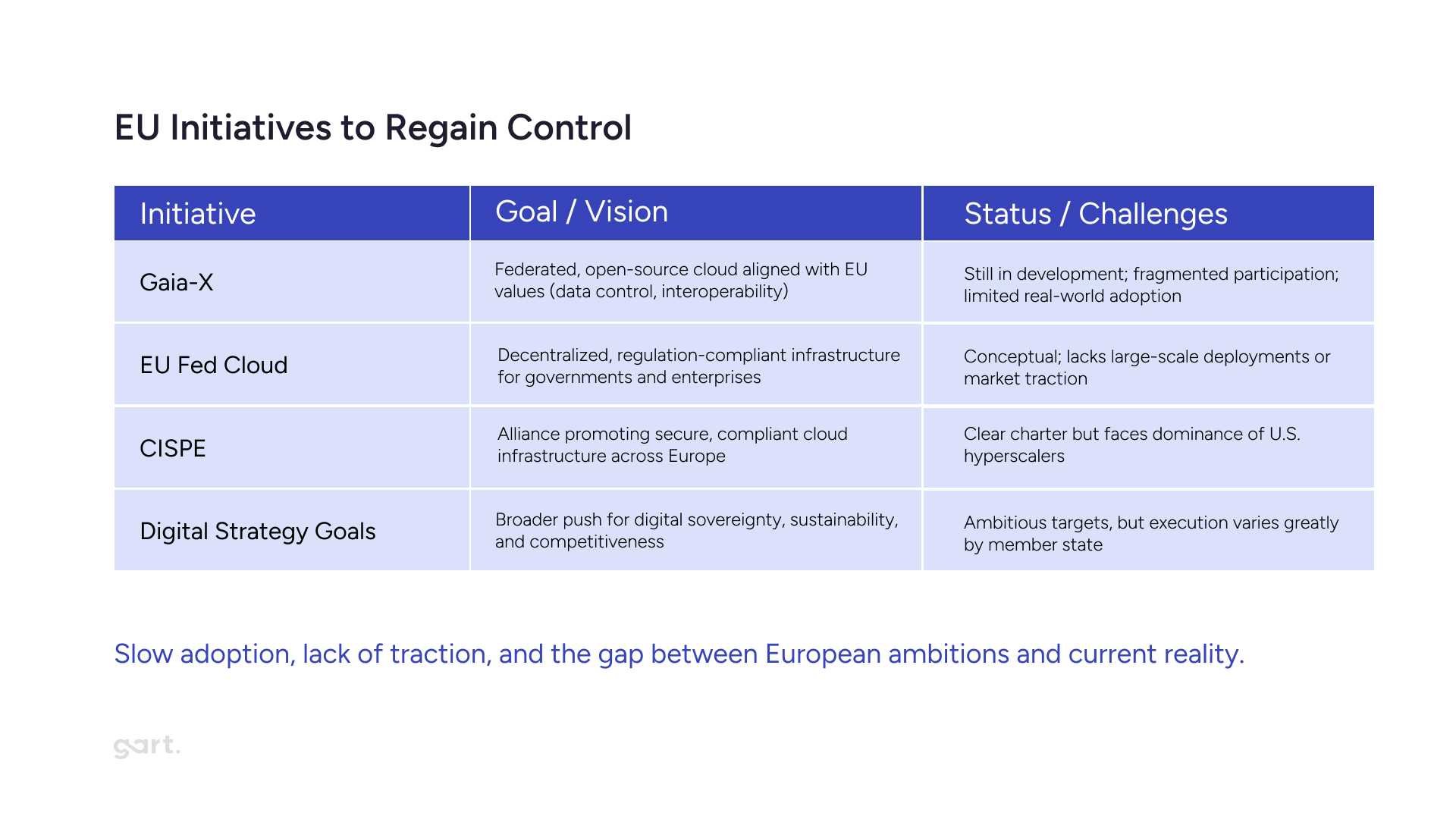
Recognising the urgency, Europe has launched several initiatives to reclaim cloud autonomy. Gaia-X was the first large-scale effort — an attempt to create a federated cloud framework based on openness and trust. However, the project has been criticised for complexity, slow progress, and the participation of U.S. firms, which undermines its foundational goals.
More recently, the EuroStack initiative has emerged as a more agile alternative. With a stronger focus on AI, digital identity, and open standards, it offers a cleaner model of European control.
At the same time, global providers are attempting to adapt. Amazon recently announced the AWS European Sovereign Cloud, promising data residency and access restrictions tailored to the EU. While it signals market demand for sovereignty, skeptics question whether such offerings truly guarantee independence or simply repackage old systems with new labels.
The EU is also working on a Cloud and AI Development Act, expected to pass in 2025. Among its goals: tripling EU cloud capacity by 2030, creating incentives for sovereign infrastructure, and ensuring that Europe does not fall behind in AI innovation due to infrastructural gaps.
It’s tempting to define European clouds by geography — data centers in France, compliance with GDPR, green energy labels. But real sovereignty goes deeper.
A truly sovereign European cloud solution must meet three core criteria:
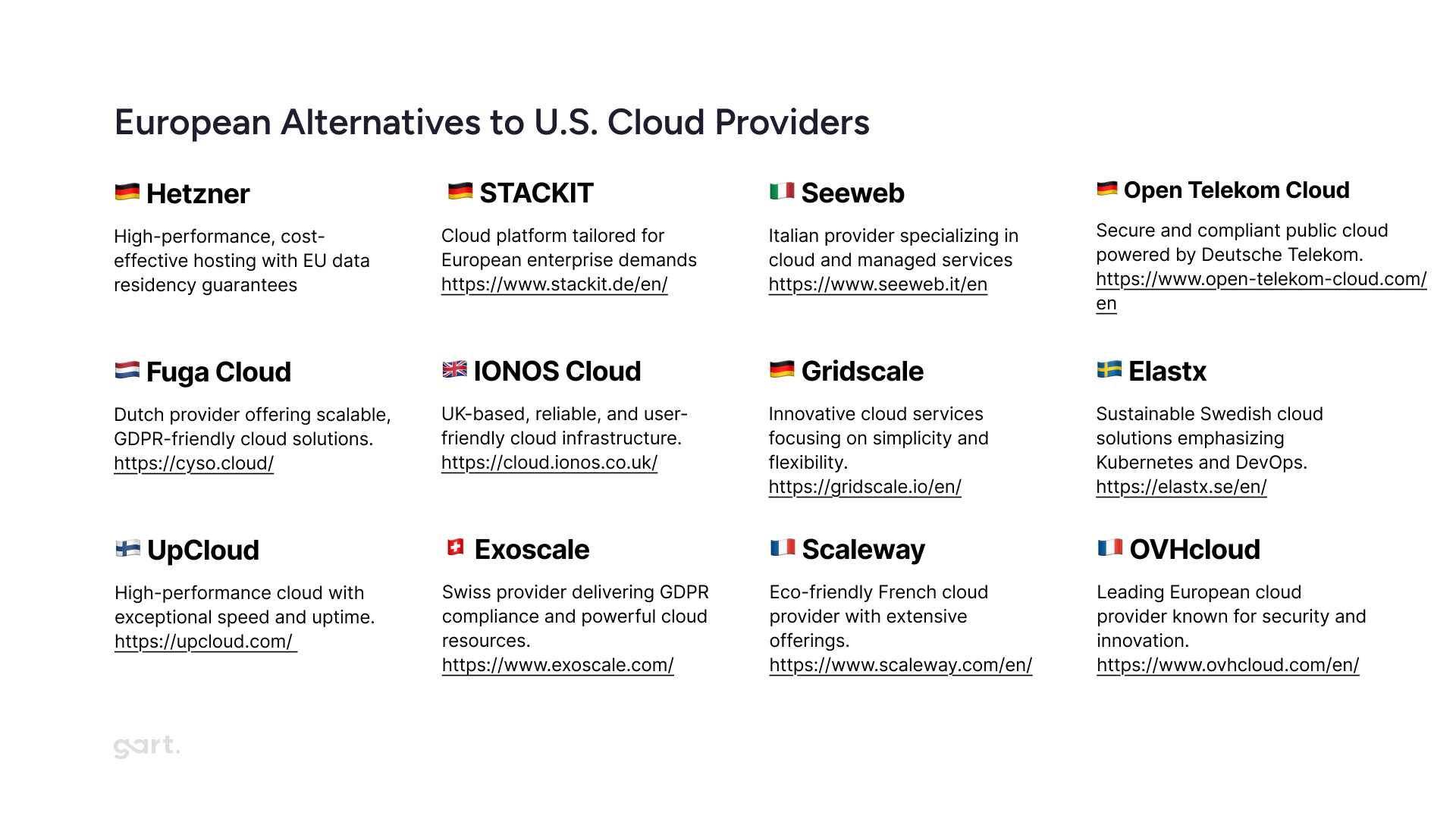
Several European providers are already delivering on these principles:
Building Your Own Path to Cloud Independence
Achieving digital sovereignty isn’t about flipping a switch — it’s about making strategic decisions that improve your resilience, compliance, and agility over time.
For many businesses, the right approach is a hybrid model: continue using hyperscalers for non-sensitive services while migrating critical systems — customer data, internal analytics, public contracts — to trusted European providers.
This process starts with a data classification framework. Not all data is equal. You need to know what’s critical, what’s sensitive, and what’s non-confidential. From there, you can set rules for where each type of data should be processed and stored.
Secondly, use open-source tools and infrastructure as code to stay agile. Technologies like Kubernetes, Ansible, and Terraform allow you to move between providers more freely — reducing vendor lock-in and increasing your negotiating power.
Finally, perform regular cloud audits. Understand where your data is stored, under what laws, and what it would take to switch providers in case of a breach, legal change, or business need. Audits aren’t just about security — they’re about future-proofing your strategy.
As Europe advances toward a more autonomous digital future, businesses have a clear role — and a clear opportunity — in shaping the next generation of cloud infrastructure.
Data is no longer a technical asset. It’s a strategic lever, a competitive differentiator, and a risk vector.
In this context, cloud independence becomes not only a matter of compliance — but a cornerstone of modern business resilience.
Need help assessing your infrastructure or building a strategy for transition? Get in touch with Gart Solutions — their experts will help you create your roadmap to digital autonomy.